Fátima Cuellar Santiago defends a doctoral thesis with an international mention on the optical and visual quality of intraocular lenses for the correction of presbyopia.
Feb 20, 2026
Fátima Cuellar Santiago will defend a doctoral thesis with an international mention, focused on the optical and visual characterization of intraocular lenses for the correction of presbyopia. The research analyzes the performance of different lens designs under controlled laboratory and clinical conditions, with the aim of improving the understanding of their visual performance prior to implantation. Defense: February 20, 2026, at 11:30 a.m. at the Joan Salvadó Auditorium and via Google Meet.
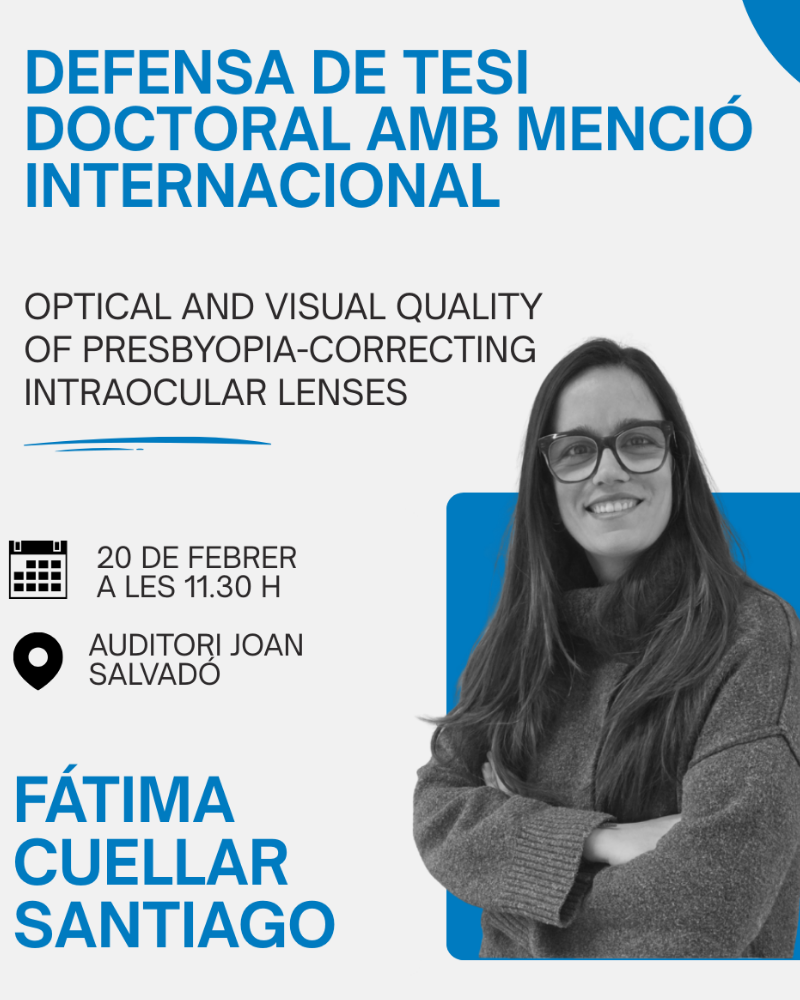
Next February 20, 2026 at 11:30 a.m. the public defense of the doctoral thesis by Fátima Cuellar Santiago, entitled “Optical and visual quality of presbyopia-correcting intraocular lenses”, which has been awarded the International Mention, will take place. The event will be held at the Auditori Joan Salvadó of the Centre Universitari de la Visió (CUV) of the Faculty of Optics and Optometry of Terrassa (Avinguda del Vint-i-dos de Juliol, 660. 08222 Terrassa) and can also be followed online through the link: meet.google.com/wbu-qxqi-hkj.
The research has been supervised by Dr. Maria Sagrario Millán García Varela and is part of the Doctoral Program in Optical Engineering of the Department of Optics and Optometry at UPC. The thesis is presented in the format of a compendium of publications.
Objective evaluation of new intraocular lens designs
The thesis focuses on the optical and visual characterization of presbyopia-correcting intraocular lenses (IOLs), a field in constant evolution due to the development and commercialization of new designs. The study emphasizes the need for an objective and quantitative evaluation prior to implantation, in order to reduce the influence of subjective and individual factors.
The research analyzes the interaction of different IOL designs —diffractive trifocal, extended depth of focus (EDOF), and enhanced monofocal (EM)— with ocular optical aberrations, in both normal and astigmatic corneas, as well as the effect of lens decentration and tilt on image quality and the risk of unwanted optical phenomena.
Preclinical methodology and clinical validation
The characterization was carried out using a preclinical optical bench equipped with a model eye, allowing control of variables that are difficult to isolate in clinical practice, such as pupil size, corneal aberrations, or lens alignment. Optical quality was assessed using metrics based on the modulation transfer function (MTF), postoperative visual acuity estimation, range of vision, and the presence of halos.
The experimental configurations approximately reproduce clinical implantation conditions, in accordance with current international standards (ISO 11979-2:2024 and ANSI Z80.35-2018), and incorporate the use of adaptive optics to introduce controlled corneal aberrations. In addition, the work includes an update of the system to allow depth-of-field scanning with tunable focal lenses.
To complement the laboratory results, the thesis also incorporates the evaluation of visual quality using the SimVis Gekko simulator, as well as clinical data obtained in collaboration with other research groups, showing high agreement with the preclinical results.
Members of the examination committee
The examination committee will be composed of:
-
Chair: Dr. Walter Daniel Furlan
-
Secretary: Dr. Irene Altemir Gómez
-
Member: Dr. Agnieszka Zielinska
Additional information
For more information about this thesis and other scheduled defenses in the Optical Engineering program, you can visit the website of the UPC Doctoral School.
Share: