Low Vision Day
Feb 24, 2026
February 26, Low Vision Day.
LOW VISION DAY
On the upcoming February 26th, from the FOOT, we want to highlight an issue that affects a large part of the population: low vision.
With this purpose, the Spanish Society of Specialists in Low Vision (SEEBV) aims to give visibility to the difficulties and experiences of people living with this visual condition, as well as to emphasize the importance of visual rehabilitation and the work of specialized professionals.
From the Faculty of Optics and Optometry of Terrassa, we want to share the material created by the student Laura Saltó in her Bachelor's Thesis (TFG) Raising awareness among the general population about low vision, supervised by Professor Núria Tomàs.
This work is a key tool for better understanding what it means to live with a significant reduction in vision.


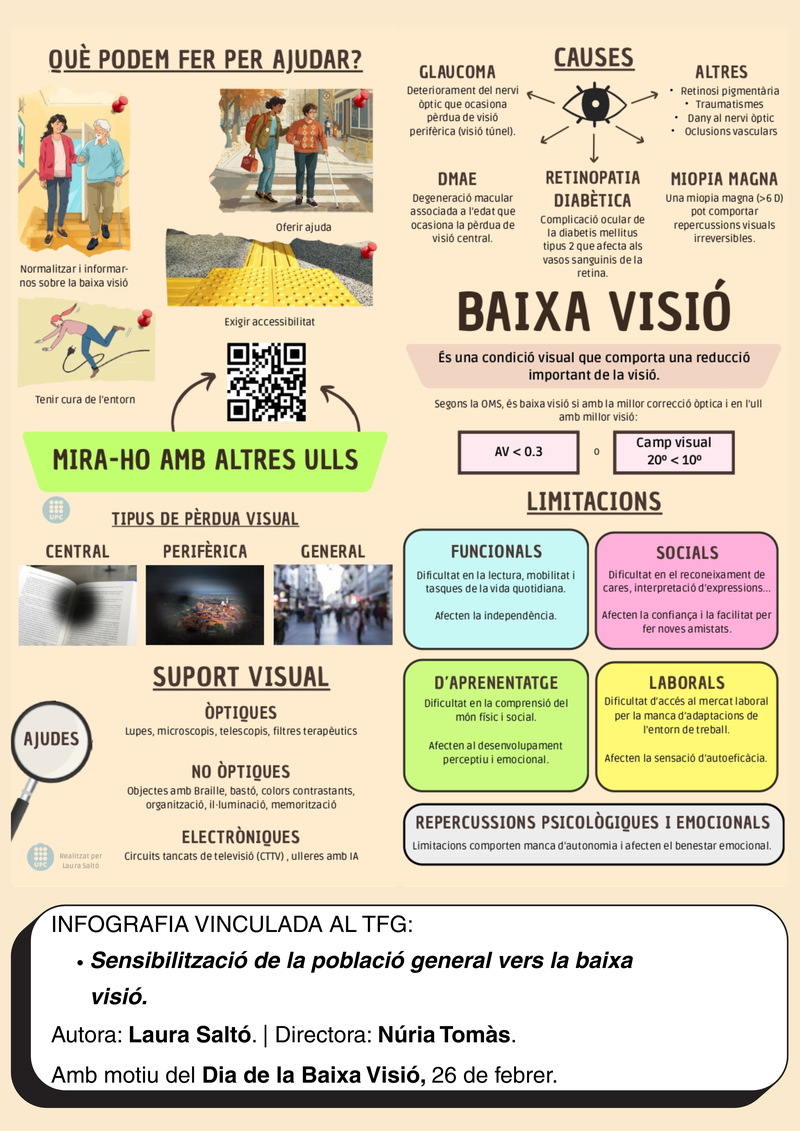
Infographics corresponding to the TFG 'Raising awareness among the general population about low vision', by student Laura Saltó
What is Low Vision?
According to the WHO, it is considered low vision when, with the best possible optical correction, the eye with better vision presents a Visual Acuity (VA) < 0.3 or a Visual Field between 20° and 10°.
-
Main causes: Glaucoma (peripheral loss), AMD (central loss), Diabetic Retinopathy, High Myopia (>6 D), and other pathologies such as Retinitis Pigmentosa.
-
Types of loss: Vision can be affected in a central way (spot in the middle that makes reading difficult), peripheral (tunnel vision), or general (blurred vision and lack of contrast).


Infographics corresponding to the TFG 'Raising awareness among the general population about low vision', by student Laura Saltó
The limitations.
Low vision entails a significant reduction in personal autonomy that manifests in different areas:
-
Functional: Difficulty in reading, mobility, and everyday tasks.
-
Social: Problems recognizing faces or interpreting expressions, which affects personal confidence.
-
Labor and learning: Barriers to accessing the labor market and difficulties in understanding the physical world.
-
Psychological: All these limitations directly impact the person's emotional well-being.
Support and tools for autonomy.
Fortunately, there are various resources to maximize residual vision:
-
Optical Aids: Magnifying glasses, microscopes, and telescopes.
-
Non-Optical Aids: Use of contrasting colors, Braille, and improved lighting.
-
Technology: Closed-circuit television (CCTV) and glasses with Artificial Intelligence.
Real testimonies: Low Vision on social media.
To get closer to the daily reality of people with visual impairment, Laura Saltó's TFG proposes a selection of Instagram accounts that show life from a pedagogical and positive perspective:
-
@lucialovesromeo: Adaptation of educational resources and family play.
-
@blindnewworld: Integration and overcoming at school and work.
-
@armengoljonatan: Advocacy for rights and use of guide dogs.
-
@matthewandpaul: Daily life with glaucoma explained through humor.
-
@loquemefaltabaporveroficial: Comedy and reflections on visual loss.
🎥 To complete all this information, you can access the explanatory video created by Laura Saltó:
Watch the video also on YouTube
Share: